
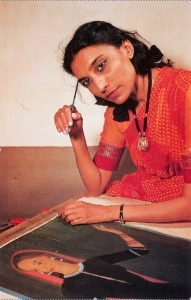
 Sughra Rababi (1922–1994) was a pioneering painter, sculptor, and designer, recognised as one of South Asia’s earliest post-Independence modernists. She distinguished herself early by becoming the first woman to win the prestigious All India Painting Competition around 1940. Over a five-decade career, Rababi developed a distinctive aesthetic that synthesised indigenous and Mughal artistic traditions with a modern sensibility. She is celebrated not only for her lyrical, figurative art but also for her profound commitment to humanitarian causes, a legacy that continues to be recognised internationally.
Rababi’s artistic journey began in Karachi with rigorous training in classical drawing at the Saranagati School of Art. Her formal education culminated in postgraduate studies at Visva-Bharati (Shantiniketan) in Bengal, the cradle of a new Indian art movement. There, under the influence of luminaries like Nandalal Bose and Abanindranath Tagore, she absorbed the philosophy of blending local traditions with modern trends. This period was crucial in shaping her unique visual language, which gained early validation with her award-winning painting, Anarkali, a work that announced the arrival of a major talent on the subcontinent’s art scene.
Rababi’s prolific career spanned from the 1940s until her final solo exhibition in San Francisco in 1992. Her vast body of work demonstrates remarkable versatility. Working in tempera, oil, and acrylic, she captured subjects ranging from bustling Karachi bazaars and intimate portraits of “Women at Leisure” to dancers and calligraphic abstractions. Her style is defined by a delicate, lyrical quality, with characteristically slender, elongated figures rendered with graceful, decorative lines. Beyond painting, she was a recognised sculptor and designer who contributed to arts education by establishing a School of Fine Arts in Karachi in 1956. Key works such as The Slave Girl and The Bride (1986) exemplify her focus on narrative and the female form.
A defining feature of Rababi’s life was her deep-seated humanitarianism. She consistently used her art as a vehicle for philanthropy, routinely donating the entire proceeds from her exhibitions to support international relief efforts in Palestine, Somalia, and Bosnia, among others. This fusion of art and activism earned her significant international acclaim. In a rare tribute, UNICEF created the “Sughra Rababi Fund” to support its global programs. Furthermore, her contributions were officially honoured by the city of San Francisco, which proclaimed January 19, 1994, as “Sughra Rababi Day” in acknowledgement of her impact as both an artist and a humanitarian.
Rababi was a prominent figure in Pakistani art circles, and it is widely noted that she was married to sculptor Ozzir Zuby. Her legacy is actively preserved and promoted by her daughter, Dr. Zeba F. Vanek. Tragically, her life was cut short in 1994 when she was killed in her studio while preparing works for a Bosnian relief benefit. Her influence endures through posthumous recognition, including a profile in David Douglas Duncan’s The World of Allah and ongoing research projects. Today, her name is immortalised through the Sughra Rababi Awards in Pakistan, which honour achievements in the arts and human rights, cementing her status as an icon of modern South Asian art.