
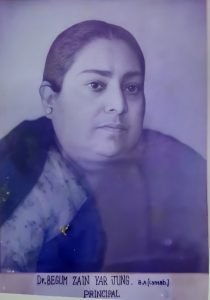
 Begum Zain Yar Jung (maiden name, Ruqaiya “Lulu” Bilgrami) was a pioneering educator and social reformer who broke barriers for women’s education and empowerment in princely Hyderabad during the 1930s and 1940s. Born into the distinguished Bilgrami family, she was the granddaughter of Nawab Sir Syed Husain Bilgrami (1844-1926), a renowned educationist and statesman who headed education under the Nizam and later served on the Secretary of State’s Council in London. She married Syed Zain-ud-Din Husain Khan (Nawab Zain Yar Jung), the Nizam’s chief architect who designed the Osmania University campus.
Ruqaiya was among the first Muslim women from India to study at the University of Cambridge, earning her B.A. (Hons.) in 1933. This achievement positioned her as a trailblazer in higher education for South Asian Muslim women. Upon returning to Hyderabad, she joined Osmania University College for Women as a lecturer and quickly rose to the position of vice-principal. In 1941, she became principal, leading the premier women’s educational institution through the challenging years of the Second World War until 1947.
Her tenure was marked by significant innovations:
-
Academic expansion: Introduced full honours courses in Political Science and English to men’s colleges
-
Infrastructure development: Secured funding for laboratories and hostel facilities, enabling science education for women on campus for the first time
-
Access initiatives: Persuaded authorities to reserve bursaries for first-generation female students, making education accessible to girls from conservative families
-
Teacher training: Established an in-house teacher-training certificate program that supplied qualified women teachers to the state’s expanding network of girls’ schools
Beyond academia, Begum Zain Yar Jung was deeply committed to women’s social and economic empowerment:
-
Employment advocacy: Through the Hyderabad Ladies’ Association, she established a Women’s Employment Bureau that secured office and nursing positions for over 300 women between 1942 and 1945.
-
Economic empowerment: Founded the Nisa Industrial Co-operative in 1944, teaching war widows and abandoned wives valuable skills in tailoring and embroidery, with products marketed through the State Handicrafts Emporium.
-
Adult education: Organised fortnightly literacy classes in collaboration with the State Central Library
-
Rural outreach: Conducted speaking tours in rural districts, addressing “mother-craft, literacy and citizenship” in both Urdu and English
Her written works included two notable pamphlets: “Modern Citizenship for the College Girl“(1943) and “Needle and Book: twin tools of freedom” (1945), which linked vocational training with liberal education.
Her contributions were recognised through several honours, including the Nizam’s Silver Jubilee Medal (1946) for “signal services to female education” and fellowship in the Indian National Social Conference (1954), making her the first woman from Hyderabad State elected to this position.
Begum Zain Yar Jung’s legacy endures through the Begum Zain Yar Jung Rolling Trophy, awarded annually at the College for excellence in Political Science. Her portrait hangs in the principal’s lodge, and the hostel block she funded is affectionately known as “Lulu House.”
She resigned in 1947 following her husband’s diplomatic appointment, but continued to mentor women students privately until she died in 1968. Her life exemplified how elite education, principled activism, and administrative excellence could advance women’s rights and higher education in princely India.