
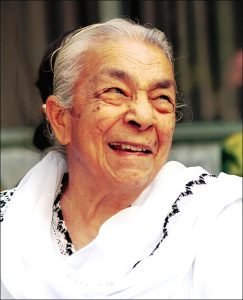
 Zohra Sehgal (1912–2014), a towering figure in Indian performing arts, was a celebrated actor, dancer, and choreographer whose remarkable career spanned nearly eight decades. Born Sahibzadi Zohra Begum Mumtaz-ullah Khan on April 27, 1912, in Saharanpur, British India, she became a symbol of resilience, artistic versatility, and secular modernism.
Born into an aristocratic Rohilla Pathan Muslim family, Sehgal displayed an independent spirit from a young age. Breaking with the conservative traditions of her time, she pursued an education at Queen Mary College in Lahore. Her passion for the performing arts led her to Europe in 1933, an extraordinary step for an Indian woman of that era. She enrolled in Mary Wigman’s prestigious modern dance school in Dresden, Germany, becoming one of the few Indians to receive formal European training in modern dance.
Her professional journey began in 1935 when she joined Uday Shankar’s groundbreaking ballet troupe. As a lead dancer, she toured extensively across India, Europe, and the United States, playing a crucial role in introducing Indian classical dance to global audiences. During her time with the troupe, she met Kameshwar Sehgal, an eight-year-younger Hindu artist. They married in 1942, challenging religious norms, and had two children.
In the 1940s, Sehgal transitioned from dance to theatre, becoming a pivotal member of the Indian People’s Theatre Association (IPTA), the cultural wing of the Communist Party of India. Through IPTA, she utilised performance as a tool for social and political commentary, contributing to the anti-colonial movement alongside luminaries such as Prithviraj Kapoor and Balraj Sahni. Her film career also began during this period with the 1946 film Neecha Nagar.
In 1962, Sehgal moved to London, where she spent over two decades building a diverse career in British theatre, television, and film. She appeared in acclaimed productions such as The Jewel in the Crown, Tandoori Nights, and My Beautiful Laundrette, and also taught at the Royal Academy of Dramatic Art (RADA).
Returning to India in the 1990s, Sehgal experienced a late-career resurgence in Bollywood. Her vivacious and charming presence in films like Hum Dil De Chuke Sanam, Dil Se, Veer-Zaara, and Cheeni Kum endeared her to a new generation of audiences. She continued working with infectious energy well into her 90s.
Zohra Sehgal’s immense contributions to the arts were recognised with India’s highest honours, including the Padma Shri, Padma Bhushan, and the Padma Vibhushan in 2010, the nation’s second-highest civilian award. After a long and vibrant life, she passed away on July 10, 2014, at the age of 102. Her legacy endures as that of a fearless and unapologetic artist who broke barriers of age, gender, and culture, leaving an indelible mark on the world of performance.