
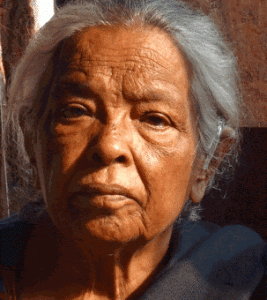
 Sughra Mehdi (1937-2014) was a distinguished Indian writer, scholar, professor, and feminist activist renowned for her significant contributions to Urdu literature and the advocacy of women’s rights. Born on August 8, 1937, in Bhopal, she was the maternal niece of the respected scholar Abid Husain. Her early life in Bhopal’s reform-minded atmosphere shaped her future path, which was further cultivated when her aunt, Saliha Abid Husain, brought her to Delhi in 1950 to join Jamia Millia Islamia’s school.
Her educational journey was extensive, including a BA from Aligarh Muslim University and culminating in a PhD from Jamia Millia Islamia. Her thesis, a critical study of the poet Akbar Allahabadi’s work, was published in 1981. Professionally, Mehdi began as a schoolteacher before becoming a freelance scriptwriter for All India Radio. Her long and impactful academic career began in 1977 when she joined Jamia’s Urdu Department as a professor, a position she held until her retirement in 1997. She also served as the editor for Jamia’s Urdu monthly, Jāmi‛ah, and the journal Islam and the Modern Age, demonstrating her deep commitment to academic and literary discourse.
Sughra Mehdi’s literary output was both prolific and influential, spanning fiction and non-fiction. She authored approximately 35 books. Her work in fiction includes five novels, most notably her acclaimed debut Pā bah Jolāñ (Feet in Fetters), and four collections of short stories. These works consistently explored feminist perspectives, advocating for social reform and delving into the lives and struggles of women. Her non-fiction contributions were equally diverse, including travelogues, critical essays, and biographical works. Among her most important scholarly works are Urdū Nāvaloñ meñ ‛Aurat kī Samājī Ḥaiṡiyat (The Social Status of Women in Urdu Novels), a comprehensive survey of female representation in the genre, and Hamārī Jami‛ah, a detailed history of Jamia Millia Islamia that paid special attention to the contributions of its women.
Beyond her academic and literary pursuits, Mehdi was a dedicated social activist. She was a founder-member and Vice-President of the Muslim Women’s Forum, established in 2000 to provide a platform for Muslim women to voice their aspirations and address societal issues. Her brand of feminism was practical, rooted in lived experience rather than abstract theory. She was a firm believer in empowering women through education and economic independence, advocating for their rights within the frameworks of the Indian constitution and Islamic principles.
Her immense contributions were recognised with several honours, including the Maikash Award and the establishment of the Sughra Mehdi National Integration Award by the U.P. Urdu Academy. She is remembered as a literary heir to Saliha Abid Husain and a crucial chronicler of Jamia’s history.
Sughra Mehdi passed away on March 17, 2014, leaving behind a rich legacy as an intellectual, educator, and reformer. Her life’s work continues to influence studies in Urdu literature, women’s history, and social activism in India.