
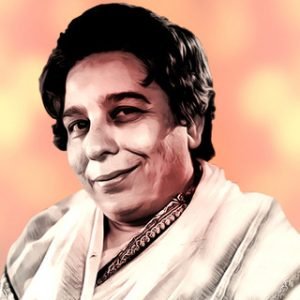
 Shamshad Begum was one of the foundational voices of the Indian film industry, celebrated as one of the very first playback singers in Hindi cinema. With a career spanning several decades, her distinctive and powerful voice graced over 6,000 songs across a multitude of languages, including Hindustani, Bengali, Marathi, and Punjabi. Her contribution to Hindi films alone accounts for nearly 1,300 songs, many of which remain iconic classics of the golden era of Indian cinema.
Born in Amritsar, Punjab, on April 14, 1919, Shamshad Begum’s musical journey began in 1931 with performances on Peshawar Radio. Her unique vocal talent quickly gained attention, leading to her film debut in the Punjabi movie Yamla Jat in 1940. From there, her career soared as she became a favourite of legendary composers like Naushad Ali and O. P. Nayyar. Her voice became synonymous with the sound of the 1940s and 1950s, producing a string of unforgettable hits. Among her most famous songs are “Mere Piya Gaye Rangoon” from the film Patanga, “Kabhi Aar Kabhi Paar” from Jogan, “Saiyan Dil Mein Aana Re” from Bahar, and the timeless classic “Kajra Mohabbat Wala” from the 1943 film Kismet.
What set Shamshad Begum apart was her remarkable vocal range and versatility. She could effortlessly navigate different genres, infusing each song with a unique energy and clarity. She was also a technical pioneer, being one of the first playback singers to utilise a microphone. This innovation allowed her powerful voice to be amplified, reaching a wider audience and helping to establish the very practice of playback singing in Indian cinema. Her songs were not only popular in their time but have demonstrated incredible longevity, with many being remixed and enjoyed by new generations of listeners.
Despite her immense success, Begum’s life had its share of challenges. Following the death of her husband in 1955, she became reclusive and took a hiatus from her singing career. However, she made a triumphant return to the recording studio in the 1960s and continued to lend her voice to films until her retirement in the 1970s.
In recognition of her monumental contributions to Indian music and cinema, Shamshad Begum was awarded the Padma Bhushan, India’s third-highest civilian honour, in 2009. She passed away in 2013 at the age of 94, leaving behind a legacy as a true pioneer who helped shape the sound of Hindi film music and paved the way for all the singers who followed.