
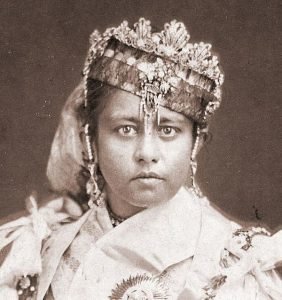
 Shah Jahan Begum (1838-1901), the third Begum of Bhopal, ruled for 57 years across two reigns (1844-1860, 1868-1901) and transformed her state into a beacon of cultural and intellectual excellence while modernising its administration and infrastructure.
Born in 1838 as the only child of Nawab Jahangir Muhammad Khan and Sikandar Begum, Shah Jahan was proclaimed Begum at age six in 1844, with her mother serving as regent. After being temporarily set aside in 1860 when the British recognised her mother as ruler, she returned to power in 1868 following Sikandar Begum’s death, beginning her transformative second reign.
Shah Jahan Begum proved herself a capable administrator, implementing comprehensive reforms that modernised Bhopal’s governance. She overhauled the land-revenue system to increase state income, professionalised the police force, and re-armed the military with improved pay scales. Her infrastructure projects included constructing dams and artificial lakes, establishing modern waterworks, and introducing Bhopal’s first postal system, which featured distinctive stamps bearing her portrait (1876-78). Most significantly, she financed the Hoshangabad-Bhopal railway line, which connected her state to India’s expanding rail network and integrated it into national trade routes.
A passionate builder, Shah Jahan Begum commissioned several monumental structures that remain landmarks today. The Taj-ul-Masajid, begun in 1874, became India’s largest mosque by area and featured innovative zenana galleries for female worshippers. Her Taj Mahal Palace (1871-84), inspired by her Mughal namesake, showcased exquisite Belgian glass and stucco work along Bhopal’s lakefront. Internationally, she funded the Shah Jahan Mosque in Woking, England (1889), Britain’s first purpose-built mosque, demonstrating her global Islamic philanthropy.
As a patron of arts and learning, Shah Jahan Begum deliberately cultivated Bhopal as an intellectual hub. Writing under the pen-name Shirin, she authored significant Urdu works including the groundbreaking “Tahzīb-un-Niswān wa Tarbiyat-ul-Insān” (1873/74), the subcontinent’s first comprehensive manual for women’s education and conduct. Her five-language dictionary “Khizānat-ul-Lughāt” (1886-87) became a scholarly reference work spanning Urdu, Persian, Arabic, Sanskrit, English, and Turkish.
Her court became a magnet for musicians, hosting renowned artists like Ghagge Nazir Khan and Wahid Khan, founders of the prestigious Mewati gharana. Regular musical soirees during Ramadan and Eid, held in her palace’s dedicated darbār-e-musīqi, attracted performers from across India.
Shah Jahan Begum championed women’s education, establishing Bhopal’s first day school in 1860 and expanding the system to include two girls’ colleges and 76 primary schools. She mandated that from 1871, no government candidate could hold office without educational certification, forcing bureaucratic modernisation. Her support extended to Aligarh’s Muhammadan Anglo-Oriental College, precursor to Aligarh Muslim University.
Honoured as Knight Grand Commander of the Star of India (GCSI) in 1872 for her loyalty during the 1857-58 uprising, Shah Jahan Begum ensured dynastic continuity by preparing her daughter, Sultan Jahan Begum, as successor. Her 63-year life bridged traditional Islamic scholarship with progressive modernisation, leaving Bhopal as a thriving centre of learning, architecture, and musical excellence that influenced Indian culture well beyond her 1901 death.
Shah Jahan Begum’s remarkable reign demonstrated how enlightened leadership could harmoniously blend political acumen, cultural patronage, and social reform, creating lasting institutions that elevated both her state and its people.