
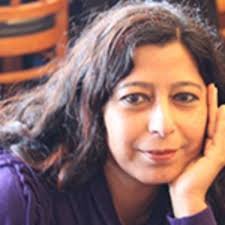
 Mehr Afshan Farooqi is a distinguished academic, translator, and literary critic specialising in Urdu and South Asian literature. Born and raised in Allahabad, India, she hails from a prominent literary family; her father was the legendary Urdu poet and critic Shamsur Rahman Faruqi. Her upbringing was deeply immersed in literary culture, as her family home was the hub for the influential Urdu journal Shabkhoon, exposing her to critical discussions on modernism from a young age. This environment, combined with a bilingual education—attending an English-medium school while receiving rigorous instruction in Urdu and Persian from her father—laid the foundation for her future scholarship. Farooqi excelled academically, earning multiple gold medals and a Ph.D. in History from Allahabad University.
Currently serving as Professor of Urdu and South Asian Literature at the University of Virginia, Farooqi’s academic career also includes positions at the University of Pennsylvania and Allahabad University. Despite an early marriage and a subsequent break from academia to raise her children, she has built an impressive and influential body of work.
Her scholarly contributions are marked by several major publications. Farooqi’s most significant editorial achievement is the two-volume The Oxford India Anthology of Modern Urdu Literature (2008), a landmark project that comprehensively documents a century of literary production across genres like poetry, fiction, drama, and essays. She has also authored critical monographs, including Urdu Literary Culture: Vernacular Modernity in the Writing of Muhammad Hasan Askari (2012), which examines the life and intellectual trajectory of Urdu’s first major literary critic. Furthermore, she edited The Two-Sided Canvas (2013), a critical volume on the writer Ahmed Ali, a founder of the All India Progressive Writers’ Association.
More recently, Farooqi has gained widespread acclaim for her extensive work on the 19th-century poet Mirza Ghalib. Her critical biography, Ghalib: A Wilderness at My Doorstep (2021), offers new perspectives by analysing his life, philosophy, and both his Persian and Urdu works, notably including a study of his “rejected” verses (mustarad kalam). This engagement with the poet continues in her latest publication, Ghalib: Flowers in a Mirror – A Critical Commentary (2024).
Farooqi’s research interests are broad, encompassing the literary cultures of northern India, bilingualism, translation, and the intersections of religion and history. Her ongoing projects include a commentary on Ghalib’s rejected verses, a book on the impact of the printing press on Ghalib’s readership, and a memoir titled A Book of Hearts. Beyond academia, she actively engages with a wider audience through a bi-monthly column in Dawn newspaper, where she writes on critical issues in Urdu literature, making complex scholarly topics accessible to the public.
Mehr Afshan Farooqi has established a distinct and independent scholarly voice. Her work successfully bridges traditional Urdu literary scholarship with contemporary academic methodologies, making the rich heritage of Urdu literature accessible to a global, English-speaking audience. Through her meticulous research, insightful biographies, and public-facing criticism, she has significantly advanced our understanding of Urdu literary culture and its key figures, securing her legacy as a vital link between traditional literary worlds and modern global academia.