
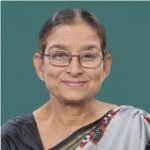
 Dr. Mamtaz Sanghamita was a remarkable Indian physician, politician, and a true pioneer who dedicated her life to both healthcare and public service. Coming from a family with a strong legacy of public service, she carved out her own path, making significant contributions in medicine and politics.
Born to a family with deep roots in public service and education, Dr. Sanghamita’s father, Syed Abdul Mansur Habibullah, was a distinguished legal and political figure who served as both Speaker and Law Minister of the West Bengal Legislative Assembly. Her mother, Maqsooda Khatoon, was an educationist and a founding member of the West Bengal Women’s Self-Defence Association, a key participant in the women’s movement. In 1975, Dr. Sanghamita married Nurey Alam Chowdhury, a barrister who later became a Senior Advocate of the Calcutta High Court and served as a Cabinet Minister in the West Bengal government. Their only daughter, Dr. Shabana Roze, followed in her mother’s footsteps and is also a medical professional.
Dr. Sanghamita’s educational journey was marked by academic excellence. She attended Municipal Girls School and Brahmo Balika Shikshalaya before earning her MBBS from Calcutta Medical College in 1968. She specialised in gynaecology and obstetrics, obtaining a DGO from the University of Calcutta and an MD from Delhi University, and later pursued advanced studies in ultrasound in the UK. She went on to become a leading gynaecologist and obstetrician, serving as the Head of the Department of Gynaecology at Calcutta Medical College and Hospital. Her work at Eden Hospital included pioneering interventional ultrasound procedures, such as amniocentesis and fetal blood sampling.
A true leader, she held several prestigious positions in medical organisations, including serving as President of the Bengal Obstetric and Gynaecological Society (BOGS) in 2003, making her the first woman secretary and later the chairperson of the Calcutta University Institute. She also served as Vice-President of the Indian Society of Perinatology and Reproductive Biology and as an executive member of the Indian Medical Association (IMA) in Kolkata, among other professional affiliations.
In 2014, Dr. Sanghamita successfully transitioned into politics, winning the Indian general election as a candidate for the All India Trinamool Congress (AITC) and becoming a Member of Parliament for the Bardhaman-Durgapur constituency. During her tenure in the 16th Lok Sabha, her parliamentary performance was commendable, with an 85% attendance rate and participation in 82 debates, well above the national and state averages. She addressed a wide array of issues in Parliament, from railway projects and procurement policies to naturopathic wellness centres and IT startups.
Beyond her professional and political life, Dr. Sanghamita was a passionate advocate for social causes, particularly women’s empowerment and welfare. She actively spoke out against the repression of women and female foeticide, and contributed her time and resources to NGOs focused on the development of women and children. She was also involved in community development, supporting religious institutions in various districts.
Dr. Mamtaz Sanghamita’s legacy is defined by her ability to bridge the worlds of medicine and public service. She was a visionary who balanced a demanding medical career with a powerful political role, all while remaining committed to social justice and the advancement of healthcare in India. She stands as a shining example of a woman who broke barriers and dedicated her life to improving the lives of others.