
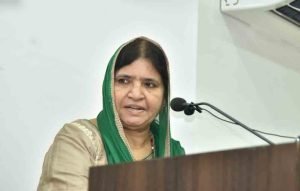
 Dr. Fatima Begum Parveen (1953–2021) was one of India’s most influential figures in Urdu literature after independence. A gold-medallist from Osmania University, she was a multifaceted personality who excelled as a scholar, critic, poet, and celebrated orator. Her profound literary insight, combined with a charismatic and engaging pedagogical style, left an indelible mark on generations of students and the wider literary community.
Born in Hyderabad to a family with deep literary roots, Parveen’s path to Urdu scholarship was unconventional. She initially pursued a Bachelor of Science degree, but a change in family circumstances led her to enrol in the Master of Arts program in Urdu at Osmania University in 1975. She distinguished herself immediately, earning two university gold medals for her exceptional academic performance. This academic success launched a long and storied career at her alma mater.
Parveen joined the Urdu faculty at Osmania University shortly after completing her MA and dedicated nearly four decades to the institution. Over her seventeen years of service, she achieved significant milestones, becoming the first Muslim woman to serve as vice-principal of the historic Arts College and eventually rising to chair the Department of Urdu. As an educator, she was revered for her ability to connect classical literary texts with contemporary issues, making them relevant and accessible to her students. Beyond the classroom, she was a commanding presence in Hyderabad’s literary circles. Her sharp, insightful, and often unsparing critiques were highly sought after, and her participation as a chief guest or panellist was considered essential for any significant book launch or literary event.
As a scholar and writer, Dr. Parveen was a formidable female voice in a field traditionally dominated by men. She authored twenty-three books spanning criticism, poetry, and translation. Her research offered fresh perspectives on canonical poets such as Amir Khusrau, Mir Taqi Mir, and Mirza Ghalib. She also produced the first modern critical evaluations of important but less-studied figures, including the Qutb Shahi court poet Ghavasi and the Progressive Movement poet Akhtar Ansari. Demonstrating her linguistic versatility and commitment to intercultural dialogue, she translated Professor N. Gopi’s renowned Telugu mini-poems, Naneelu, into Urdu, making them accessible to a new audience.