
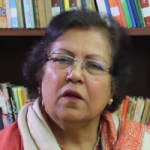
 Azra Naqvi is a prominent figure in contemporary Urdu literature, recognised for her contributions as a poet, short-story writer, translator, and cultural advocate. Born in Delhi, India, in 1952, she comes from a family deeply rooted in literary and intellectual discourse. Her mother was a poet who wrote ghazals, and her aunt, Dr. Sughra Mehdi, was a renowned Urdu writer and professor at Jamia Millia Islamia. Growing up in a diverse and harmonious neighbourhood in Delhi during the 1950s and 60s, Naqvi’s early life was marked by a sense of communal harmony that would later influence her work.
Naqvi’s professional journey began in the mid-1970s at All India Radio’s External Service Division, where she worked as an announcer for the Urdu service. For nearly three decades, she lived abroad, accompanying her husband to countries including Iraq, Saudi Arabia, and Canada. This international experience provided her with rich material for her creative work, exposing her to different cultures and literary traditions, particularly Arabic literature. During this time, she also wrote columns for both English and Urdu newspapers, including the Saudi Gazette and Urdu News.
Her literary works are characterised by a focus on themes of cultural displacement, immigrant experiences, and nostalgia. Her poetry collections, which include Dil Ke Mausam (2012), Mere Shab-o-Roz, and Sher-Kitaabein-Yadein (2019), demonstrate her ability to blend traditional Urdu poetic forms with contemporary themes. Her short story collections, such as A’ngan jab Pardes Hua (2013) and Jahan Bana Lein Apna Nasheman, explore the challenges and nuances of maintaining cultural identity while adapting to new environments. She has also authored other prose works, including Mere Watan Ki Khushbu (2022) and the educational book Urdu Shabdon Ka Guldasta (Urdu Word Power Made Easy).
One of Naqvi’s most significant contributions is her translation work, through which she has introduced contemporary Arabic literature to Urdu-speaking audiences. Her major translation, Saudi Arab ki Qalam kar Khwateen ki Muntakhab Kahaniyan (2008), is a collection of selected stories by Saudi women writers. She also translated Voices of Change, another collection of short stories by Saudi women. These projects highlight her commitment to cross-cultural literary exchange and her dedication to promoting women’s voices in literature.
Beyond her own writing, Naqvi is a dedicated cultural advocate. She serves as the Vice President of BANAT (Bainul Aqwami Nisaai Adabi Tanzeem), an International women’s Urdu Literary organisation founded in 2017. The organisation, which began with just four members and has since grown to include 125 members globally, is dedicated to promoting Urdu literature and supporting new women writers. BANAT holds two annual programs and requires all communications to be in Urdu, ensuring an immersive environment for language preservation. Naqvi is also associated with the Rekhta Foundation, a major digital platform for Urdu literature, where she continues her work in preserving and modernising the dissemination of the language.
Her advocacy extends to promoting Urdu education. She consistently emphasises the importance of teaching Urdu to children to ensure the intergenerational transmission of the language and its rich literary legacy. While the provided sources do not mention specific major awards, her active participation in literary festivals and leadership roles in organisations like BANAT and Rekhta demonstrate the high regard she holds within the Urdu literary community.
Azra Naqvi’s work bridges traditional literary forms with modern global experiences. Through her multifaceted contributions as a writer, translator, editor, and cultural advocate, she has played a vital role in maintaining the vibrancy and relevance of Urdu literature in the 21st century. Her writings offer valuable insights into the immigrant experience and the enduring power of linguistic and literary tradition.