
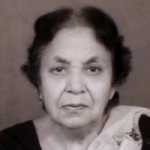
 Born into a family of scholars and merchants in 1926 in Badayun, Uttar Pradesh, Aziz Bano Darab Wafa emerged as one of the 20th century’s most notable progressive Urdu poetesses. Her family’s unique background, with roots in Kashmir’s shawl trade and a history of intellectualism, cultivated a progressive environment that supported her education and later, her literary pursuits.
After earning her master’s degree in English from Lucknow University in 1949, she began her career as an English lecturer. Her strong foundation in English literature, combined with her fluency in Urdu, allowed her to blend modern sensibilities with classical Urdu poetic forms. Initially, she wrote poetry as a private, therapeutic exercise, not intending to publish her work. This changed dramatically in 1960 when she participated in a poetry gathering (mushaira) and received praise from Indira Gandhi, which launched her into the public eye.
Following this recognition, Aziz Bano became a popular voice on radio programs and a frequent participant in both domestic and international mushairas. Her recitations were admired for their emotional depth and technical skill, cementing her reputation as a prominent poet. Her primary literary legacy is the posthumously published collection, “Goonj” (Echo), which showcases her distinctive style and thematic range. She also authored “Isami Firdousi-e-Hind,” demonstrating the breadth of her literary interests.
Aziz Bano’s poetry is characterised by its rich exploration of personal emotions and broader social concerns. As a progressive writer, she aligned with the Progressive Writers’ Movement, using her work to advocate for social justice and equality. Her verses, however, are particularly significant for giving voice to feminine experiences within a male-dominated literary tradition. While she was able to convey the deep introspection of a woman’s life, she never shied away from engaging with larger social and political issues.
She was connected to a network of influential women writers, including Qurratulain Hyder, Rafia Shabnam Abidi, and Sajida Zaidi. This association highlights her role as part of a collective of female authors who challenged and reshaped Urdu literature during the mid-20th century. Her work bridges the gap between traditional and modern poetry, demonstrating how a profound understanding of life can lead to innovative and diverse perspectives. Her verses are renowned for their profound emotional insight, whether exploring themes of memory and longing, resilience and hope, or the harsh realities of life. For example, a well-known verse of hers reads, “I didn’t plant trees of dreams thinking / Who in the wilderness would water the growing tree,” speaking to the challenges of nurturing hope in a difficult world.
Aziz Bano Darab Wafa passed away in 2005, leaving a lasting legacy in Urdu poetry. Her work is a testament to the power of a woman’s voice in a traditionally male-dominated field, especially within the Progressive Writers’ Movement, where female poets were relatively rare. Her posthumous publications and the continued accessibility of her work on platforms like Rekhta ensure that her poetry continues to resonate with new generations. Her contributions not only expanded the space for women’s voices but also demonstrated that poetry could be both deeply personal and politically engaged, paving the way for future generations of feminist writers. Ultimately, her work embodies the essence of her collection’s title—an enduring “echo” of a voice that helped shape the future of Urdu literature.