
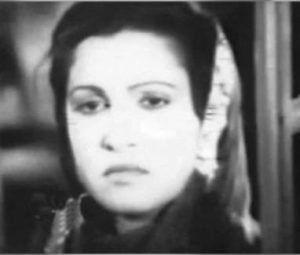
 Shamim Bano (29 July 1920 – 23 October 1984), known professionally as Shamim, was a prominent and acclaimed actress in the Indian and Pakistani film industries during the 1940s and 1950s. Remembered for her leading role in Dilip Kumar’s debut film ‘Jwar Bhata‘, she successfully navigated a career through the pivotal period of the Partition of India. Born Shamim Bano Begum into a Pathan family in Lahore, British India, she was related to the celebrated singer-actress Khurshid Begum and was a cousin to the legendary actress Meena Kumari. Drawn to the world of cinema, she moved to Bombay to pursue an acting career. Following the Partition in 1947, she relocated to Pakistan. There, she married the esteemed film director Anwar Kamal Pasha, the son of noted writer Hakim Ahmad Shuja. After starring in several successful Pakistani films, she retired from the industry to focus on her family, with whom she had three children.
Shamim Bano rose to fame in the early 1940s, becoming a leading star for major studios like Ranjit Movietone. A key success from this period was Armaan (1942), where she starred opposite Motilal, solidifying her status as a top-tier actress. Her most significant contribution to Bollywood history was starring as the female lead in Jwar Bhata (1944). The film is a landmark of Indian cinema as it marked the acting debut of the legendary Dilip Kumar, with Shamim Bano as his first co-star. This role cemented her place in cinematic history. Further showcasing her versatility, Shamim took on a bold and socially relevant role in Sindoor (1947). The film courageously tackled the controversial subject of widow remarriage, a taboo topic at the time. Her portrayal of the central character, a young widow who challenges societal norms, was pivotal to the film’s narrative and impact.
After migrating to Pakistan, Shamim Bano continued her successful career. She starred in Shahida (1949), one of the fledgling nation’s earliest films, which co-starred Nasir Khan (Dilip Kumar’s brother). Her biggest Pakistani success came with Do Ansoo (1950), directed by her husband. The film was a monumental success, becoming the first-ever Urdu film in Pakistan to achieve a silver jubilee, a testament to its popularity and Shamim’s enduring star power. Shamim Bano’s legacy is that of a talented and graceful actress who was a leading star in pre-partition India and went on to become a foundational figure in the early years of Pakistani cinema. She passed away in Lahore on 23 October 1984.