
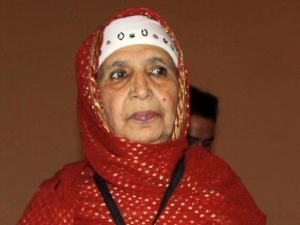
Rehti Begum, known to the world as Raj Begum, was a celebrated cultural icon and pioneering female singer from Kashmir, hailed as the “Nightingale of Kashmir.” Born on March 27, 1927, in Srinagar, she was a trailblazer who overcame the conservative social norms of her time. Despite growing up in a poor family with limited opportunities for girls, her father, Ghulam Rasool Sheikh, nurtured her musical talent. She began her career by singing at weddings to support her family, where her powerful and unique voice quickly garnered attention.
Her professional life took a decisive turn in 1954 when she joined Radio Kashmir Srinagar. This platform allowed her to broadcast her talent widely, becoming a permanent staff artist and a defining voice of the station for over three decades. At a time when female artists were heavily constrained by societal expectations, her uninhibited, high-pitched, and melodious voice was a revolutionary force. She broke the social stigma associated with women performing publicly, paving the way for future generations of female artists. Her renditions of songs, particularly the love tale of Gulrez, captivated audiences and made her a mainstay of the live broadcasting era.
Raj Begum’s musical repertoire was vast and versatile. She was a master of Kashmiri folk music, ghazals, and devotional songs, and is credited with introducing the semi-classical genre of Thumri to the region. Her profound understanding of ragas and talas, combined with her innate ability to compose, elevated her status as a musical innovator. Her songs, such as Vyasiye gulan aavuy bahar and Meshreavthas Janaan, have become timeless classics, integral to Kashmir’s cultural heritage. She is estimated to have sung thousands of songs, though many were never formally recorded.
Raj Begum’s contributions were widely recognised with prestigious accolades. In 2002, she received the Padma Shri, India’s fourth-highest civilian award, and in 2013, she was honoured with the Sangeet Natak Akademi Award, the highest national recognition for performing artists. The state of Jammu and Kashmir also presented her with its state award in 2009.
Beyond her musical talent, Raj Begum’s legacy is her role as a cultural pioneer and a symbol of women’s empowerment. She served as a crucial cultural bridge, preserving traditional music while simultaneously challenging patriarchal norms. Her life and work have been commemorated in a government-produced documentary, Her Theme of Freedom: Raj Begum, and more recently, a biographical film titled Songs of Paradise, featuring Saba Azad and Soni Razdan.
Raj Begum passed away on October 26, 2016, at the age of 89. Her death marked the end of a great era in Kashmiri music and was mourned by political figures and artists alike. Her enchanting voice, famously described by Bollywood legend Dilip Kumar as a sound that would ensure Kashmir’s voices would “never die,” continues to resonate, cementing her status as an enduring symbol of the region’s cultural identity.