
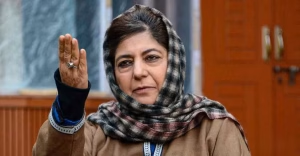
 Mehbooba Mufti is a formidable figure in the politics of Jammu and Kashmir (J&K), best known for becoming the region’s first and only female Chief Minister. Born in 1959 in Bijbehara, she is the president of the Jammu and Kashmir Peoples Democratic Party (PDP), a political party founded by her late father, Mufti Mohammad Sayeed, who also served as Chief Minister of J&K and as India’s Union Home Minister.
Educated with a law degree from the University of Kashmir, Mehbooba entered the political arena in 1996, winning a seat in the State Assembly as a member of the Indian National Congress. However, her political identity was truly forged in 1999 when she and her father established the PDP. The party emerged with a “healing touch” policy, aiming to address the grievances of the Kashmiri people through dialogue, reconciliation, and advocating for human rights. This platform resonated with many, leading to her election to the Lok Sabha, India’s lower house of Parliament, representing Anantnag in 2004 and again in 2014.
Following her father’s death in 2016, Mehbooba Mufti took the reins of a contentious coalition government with the Bharatiya Janata Party (BJP). Her tenure as Chief Minister, from April 2016 to June 2018, was fraught with challenges. It was marked by widespread unrest following the killing of militant commander Burhan Wani and the inherent ideological friction of the PDP-BJP alliance. The coalition ultimately collapsed in 2018 when the BJP withdrew its support, citing concerns over the security situation.
The most defining period of her recent career began on August 5, 2019, when the Indian government abrogated Article 370, revoking J&K’s special autonomous status. Mufti, along with other mainstream Kashmiri leaders, was placed under detention for over a year. Upon her release, she became a staunch critic of the central government’s actions and was a key architect of the People’s Alliance for Gupkar Declaration (PAGD), a coalition of regional parties advocating for the restoration of autonomy.
Despite its initial unity, the PAGD faced internal fractures, particularly between the PDP and the National Conference, leading them to contest the 2024 elections separately and weakening the alliance’s impact. In the aftermath of electoral setbacks, Mufti has continued to lead the PDP, persistently calling for dialogue between India and Pakistan and urging the central government to adopt a political, rather than a purely security-based, approach to the Kashmir issue. Her political legacy remains complex: she is seen as both a trailblazer for women and a pragmatic politician who attempted to bridge the divide with New Delhi, yet is also criticised for her alliance with the BJP. Today, she remains a prominent and resilient opposition voice in the evolving political landscape of Jammu and Kashmir.