
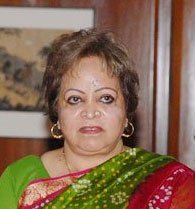
 Salma Ansari, wife of former Indian Vice President Mohammad Hamid Ansari, has forged a public identity defined by decades of grassroots social work, particularly in education and women’s empowerment. Her journey as a social activist was catalysed during her time in Aligarh, where, as a distinguished alumna of Aligarh Muslim University (AMU), she witnessed the stark reality of “abject poverty, deprivation and denial” in the city’s slums. This firsthand experience prompted her to dedicate her life to the educational upliftment of marginalised communities.
She married Mohammad Hamid Ansari, a distinguished diplomat and politician from a family of Ansari sheikhs tracing descent from the Sufi saint Abdullah Ansari. The couple has three children: two sons and one daughter. Her life has been closely intertwined with her husband’s public service career, during which she maintained a low-profile yet active role in philanthropy.
Her most significant contribution is the Al-Noor Charitable Society, founded to provide education as a means to overcome poverty. The society operates several schools in the slum areas of Aligarh and Delhi, including Qila Public School, Chacha Nehru Public School (also known as Chacha Nehru Madrasa), and Al-Noor Public School. These schools provide education to nearly 4,000 children from the families of daily wagers and labourers, including approximately 1,100 from Hindu communities, providing a blend of religious and secular education. Her work is seen as a modern revitalisation of the Aligarh Movement’s legacy, applying its principles of social reform through education to contemporary challenges. The schools offer a model of radical inclusion, providing free books, uniforms, and midday meals, and uniquely allowing children to enrol at any age to accommodate those who have dropped out or never had a chance to start. The curriculum is modern, focusing on 21st-century skills and vocational training.
Beyond education, Salma Ansari is a courageous voice for women’s empowerment. In 2017, during the national debate on instant triple talaq, she publicly condemned the practice, stating it had no basis in the Quran. She urged Muslim women to read the scripture for themselves rather than blindly relying on clerical interpretations, advocating for their intellectual and spiritual autonomy. Her commitment to women’s economic independence is demonstrated by her support for initiatives like ‘Dastarkhwan,’ a canteen at Jamia Millia Islamia run exclusively by women from a local self-help group.
Salma Ansari has not authored any books herself, though her work has been chronicled in a biography, Colours of My Rainbow, written by Himani Verma, and in documentary films. The book was launched in the presence of Bollywood actor Aamir Khan, who praised her contributions to societal upliftment.
While she has not been the recipient of major personal awards, her work has received international recognition, notably when a documentary on her Al-Noor Charitable Society won a Telly Award in New York. Her legacy is not defined by personal accolades but by the tangible, transformative impact of her grassroots activism and her principled stance on social reform.