
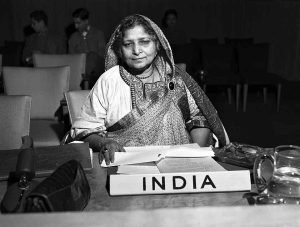
 Shareefa Hamid Ali (c. 1883–1971) was a pioneering Indian feminist, nationalist, and social reformer who played a crucial role in the fight for women’s rights in the 20th century. A key architect of the Indian women’s movement, she was a woman of remarkable foresight and determination, whose work had a lasting impact both nationally and internationally.
Born into the progressive and influential Tyabji family in Gujarat, her father was Abbas Tyabji, a prominent freedom fighter. This environment instilled in her a strong sense of social justice and a liberal outlook. She was multilingual, fluent in Urdu, Gujarati, Persian, Marathi, English, and French. In 1907, her attendance at an Indian National Congress session sparked her deep involvement in the nationalist cause and the Swadeshi Movement.
Hamid Ali’s most significant work was through the All India Women’s Conference (AIWC), which she helped found in 1927. She held numerous leadership positions within the organisation, including Honorary Treasurer, Chairwoman, Vice-President, and President. Through the AIWC, she championed critical social reforms. She was a fierce opponent of child marriage, organising campaigns to build support for the Sarda Act (Child Marriage Restraint Act) of 1929 and arguing for the minimum age of marriage to be 18. She also challenged the restrictive practice of purdah (seclusion), advocating for women’s education and their right to participate in public life.
Her influence extended far beyond India’s borders. In 1933, she was one of three women delegates at the Round Table Conference in London, where she demanded equal political rights for all. A true internationalist, she represented the AIWC at the Istanbul Congress of the International Alliance of Women and the Women’s International League for Peace and Freedom congress in Czechoslovakia. Most notably, in 1947, she became one of the fifteen founding members of the United Nations Commission on the Status of Women, helping to draft the guiding principles of the commission and advocating for gender-inclusive language in the Universal Declaration of Human Rights.
Shareefa Hamid Ali’s legacy is that of a tireless advocate who fought on multiple fronts—for national independence, for the upliftment of marginalised communities, and, most powerfully, for the emancipation of women. Her work in education, law, and politics helped lay the essential groundwork for the advancement of women’s rights in modern India.