
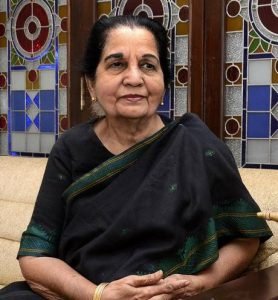
 Jeelani Bano is a prominent figure in Urdu literature, known for her insightful portrayal of social, cultural, and political realities, especially those of Hyderabad, where she spent much of her life. Born on 14 July 1936 in Badayun, Uttar Pradesh, she inherited her literary flair from her father, Hairat Badayuni, a noted poet. Growing up in a vibrant literary environment, she was greatly influenced by frequent visits from eminent progressive writers like Sajjad Zaheer, Krishan Chander, and Majrooh Sultanpuri. This exposure, combined with her extensive reading of literary figures such as Manto, Ghalib, Iqbal, Chekhov, and Qurratul-Ain Hyder, shaped her mature and distinctive literary voice.
Jeelani Bano began her writing career with film articles before moving on to fiction. Her first short story, Ek Nazar Idhar Bhi, appeared in 1952, and her breakthrough story, Moum Ki Mariam, gained wide acclaim. Her first short story collection was Raushni ke Minar, and her debut novel was Aiwaan-e-Ghazal. Other major novels include Baarish-e-Sang, Nirvaan, Jugnu aur Sitare, and Naghme Ka Safar. At the same time, her story collections, such as Paraya Ghar, Raat ke Musafir, and Baath Phoolon Ki, significantly enriched Urdu literature.
Jeelani Bano’s writings are deeply rooted in realism, mirroring the societal shifts of post-independence India. Her work highlights the fall of the jagirdari (feudal) system, the rise of peasant revolts, and the impact of rapid industrialisation. She wrote during the peak of the Progressive Writers’ Movement, and while she is considered a progressive writer, she avoided ideological rigidity. Her focus remained on portraying the human condition, especially the injustices faced by women, the poor, and the socially marginalised.
Her stories explore complex themes such as displacement, alienation, and gender inequality. In Sukhi Ret and Mere Marne Ka Dukh, she movingly portrays the trauma of migration and the emotional dislocation experienced by characters caught between lands and identities. Agahi explores the awakening of a woman, Sitara, who learns to break free from traditional patriarchal expectations. Stories like A Day In The Labor Room and A Cigarette Smouldering In The Ashtray poignantly depict the silent suffering of women in a male-dominated world. Despite the serious themes, Jeelani Bano never indulges in melodrama or didacticism. Her tone remains compassionate, observant, and subtle.
Unlike her contemporaries, she does not make her characters passive victims; many eventually find a way forward. Her narratives are marked by humanitarianism, objectivity, and emotional restraint. She uses simple, everyday language to express complex social issues effectively. According to critic Taqui Ali Mirza, her hallmark is her deep empathy for the underprivileged, especially women.
While earlier Hyderabadi women writers like Tayyaba Begum or Jahan Bano Begum Naqvi either imitated Western writers or conformed to conventional tropes, Jeelani Bano stood out for her originality and social engagement. Though she depicted the lives of the oppressed, she avoided propagandist literature, earning her a distinct place as a socially conscious yet artistically balanced writer.
Jeelani Bano has received numerous honours, including the Andhra Pradesh Sahitya Akademi Award (1960), the Sovietland Award, and the Hali Award from Haryana Urdu Academy (1976), cementing her legacy as a leading voice in modern Urdu fiction.