
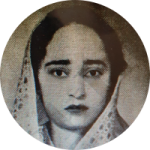
 Begum Zakia Sultana Nayyar was a prominent Urdu figure who dedicated her life to the cause of Indian independence, social progress, and the preservation of literature. Born on April 11, 1924, in Moradabad, Uttar Pradesh, she passed away on October 10, 2007, in Delhi, leaving behind a rich legacy as a freedom fighter, social activist, poet, and writer. She was driven by her passion for nationalism, secularism, and women’s empowerment.
Zakia Sultana came from an educated landlord family and was educated at home. She married the renowned Urdu poet Saghar Nizami on March 28, 1943. Saghar Nizami was a Padma Bhushan recipient and one of Seemab Akbarabadi’s earliest disciples. The couple collaborated on promoting Urdu literature and nationalist ideals. Zakia Sultana was survived by her daughter and three sons.
Zakia Sultana’s literary contributions were extensive, particularly her autobiographical and biographical works. Her books, “Beetay Lamhay” and “Yaadon Kay Chiragh” (Lamps of Memory), offered valuable insights into her life and that of her husband. These works are considered essential historical documents that capture the literary and cultural environment of their time. She also wrote “Saghar Nizami: Fun aur Shakhsiat,” a comprehensive biography of her husband, and “Vaadiyan.” A significant achievement was her compilation of Saghar Nizami’s collected works, “Kuliyat-e-Saghar Nizami,” published in three volumes. She also authored an anthology of poetry titled “Naya Raag.”
Beyond her own writing, Zakia Sultana was a key member of the editorial team for her husband’s Urdu magazine, “Asia,” where she used the name Zakia Sultana Saghar. Her editorial work enabled her to shape literary discourse and support emerging writers, showcasing her profound commitment to high-quality literature.
Zakia Sultana was a tireless social activist who founded and led several important organisations. She was a founding member of the Lok Kalyan Samiti, dedicated to social welfare and community development. She also played a foundational role in the Delhi Mahila Samaj and the Young Women’s Hostel, organisations focused on women’s empowerment. Her involvement with Anjuman Khawateen further demonstrated her dedication to social reform within the Muslim community. She held various professional and educational roles, serving as Treasurer of the Business and Employment Bureau and ex-chairperson of the NDMC Education Sub-Committee. She was a member of the governing body at Gargi College and a founder and executive member of the managing committee for Crescent Public School, highlighting her dedication to education despite her limited formal schooling.
Recognised as an ardent nationalist and freedom fighter, Zakia Sultana and her husband used their literary work to promote nationalism and secularism. Her political consciousness was shaped by her admiration for prominent women leaders, such as Sucheta Kriplani, Sarojini Naidu, and Indira Gandhi, who exemplified the strength and spirit of Indian women. These role models inspired her to advocate for women’s empowerment while upholding strong patriotic values.
Begum Zakia Sultana Nayyar’s legacy is defined by the intersection of literature, social service, and political consciousness. Her work in preserving Urdu literature and compiling her husband’s works ensured that a significant literary heritage would be accessible to future generations. Her social activism created lasting institutions that continue to serve the community. She championed education as a means of social transformation, and her feminist perspective, though not explicitly labelled as such, was evident in her focus on women’s organisations and her inspirational role models.
Begum Zakia Sultana Nayyar’s life story is a testament to the often-unrecognised contributions of women who worked tirelessly behind the scenes to build modern India and preserve its cultural heritage. Her dedication to nationalism, secularism, and women’s empowerment remains her most enduring legacy.