
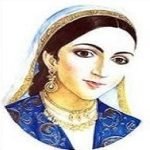
 Zaibunnisa Makhfi (1638–1702) was a highly educated Mughal princess, a gifted Persian poet, and a prominent figure in the intellectual and cultural life of the 17th-century Mughal Empire. The eldest child of Emperor Aurangzeb and his chief consort, Dilras Banu Begum, she was a scholar of exceptional intellect whose life was marked by a profound spiritual quest and a tragic conflict with her orthodox father. She is best known for her poetic legacy, encapsulated in the collected works of her Diwan-i Makhfi, written under the pen name “Makhfi,” which means “The Hidden One” in Persian.
Born into the wealthiest and most powerful family of her time, Zaibunnisa was raised with an education that was rare for women, even in royal circles. Her father, Aurangzeb, was a scholar of Islamic jurisprudence who took great pride in her intellect. By the age of seven, she had memorised the entire Quran and was a skilled calligrapher. She was tutored by Hafiza Mariam, one of the most learned women of the era, and mastered Persian, Arabic, and Urdu. Her studies extended beyond religious texts to encompass mathematics, astronomy, philosophy, and history, laying the foundation for her intellectual curiosity.
Her pen name, “Makhfi,” was a deliberate choice that reflected the dichotomy of her life. On one hand, it symbolised her preference for a secluded life dedicated to study and spiritual reflection, away from the public eye. On the other hand, it was a poignant metaphor for her hidden identity as a poet whose works clashed with her puritanical father’s orthodoxy. Aurangzeb famously banned music, art, and poetry from his court, forcing her to pursue her passion in secret.
Zaibunnisa’s primary contribution was her poetry, which is regarded as one of the finest examples of Indo-Persian literature. Her magnum opus, the Diwan-i Makhfi, is a collection of over 400 ghazals. The poems are deeply steeped in Sufi mysticism, exploring the relationship between the lover (the human soul) and the Beloved (God). She used rich metaphors—such as the moth and the flame, and the nightingale and the rose—to convey the intensity of her spiritual longing. Her famous couplet, “I am an infidel of Love and do not need faith and prayer / I bow before the image of my Love, no Muslim I,” starkly illustrates her spiritual universalism and her rejection of rigid dogma, which was in direct opposition to her father’s worldview.
She was also a literary patron, maintaining a large library of books and manuscripts. She financially supported scholars, poets, and writers across the Mughal Empire, often commissioning copies of rare texts. In addition to her poetry, she is credited with other notable works, including:
- Zeb ‘ul-Tafasir: A commentary on the Quran, though its authorship remains debated.
- Zeb ‘ul-Monsha’at: A collection of her prose and literary compositions.
Zaibunnisa’s works were a powerful expression of her spiritual independence, demonstrating how she found liberation through poetry in a life constrained by imperial politics and religious strictures.
Zaibunnisa’s contributions were not limited to the literary sphere. She was a renowned patron of the arts and scholars, using her wealth to aid the less fortunate. She provided charity to widows and orphans and sponsored pilgrims for the Hajj. One of her unique social contributions was the design of the Angya Kurti, a modified version of the Turkestani women’s dress that was adapted to the climate and culture of India, which became a popular garment.
Her relationship with her father was complex. While he was proud of her intelligence, her love for poetry and liberal spiritual views created deep friction. The final and most significant source of conflict was her rumoured support for her rebellious younger brother, Prince Muhammad Akbar, who had revolted against Aurangzeb in 1681. This is the most widely cited reason for her subsequent imprisonment at Salimgarh Fort in Delhi, where she spent the last 20 years of her life.
Zaibunnisa’s story stands in contrast to her paternal aunts, Jahanara Begum and Roshanara Begum, who were both powerful political figures in their own right. Jahanara was a renowned Sufi patron and builder, while Roshanara was a shrewd political ally of Aurangzeb. Zaibunnisa, however, used her intellectual and spiritual pursuits to carve out her own distinct identity, choosing the path of a scholar and mystic over that of a political player.
Zaibunnisa died in 1702 while still imprisoned. Her tomb was originally located in a garden in Delhi, but was later demolished and moved to the mausoleum of Emperor Akbar in Sikandra, Agra, when railway lines were constructed. Although her life ended in confinement, her legacy as a brilliant poet, a fearless spiritual seeker, and a symbol of female intellectual and spiritual resilience has endured.